

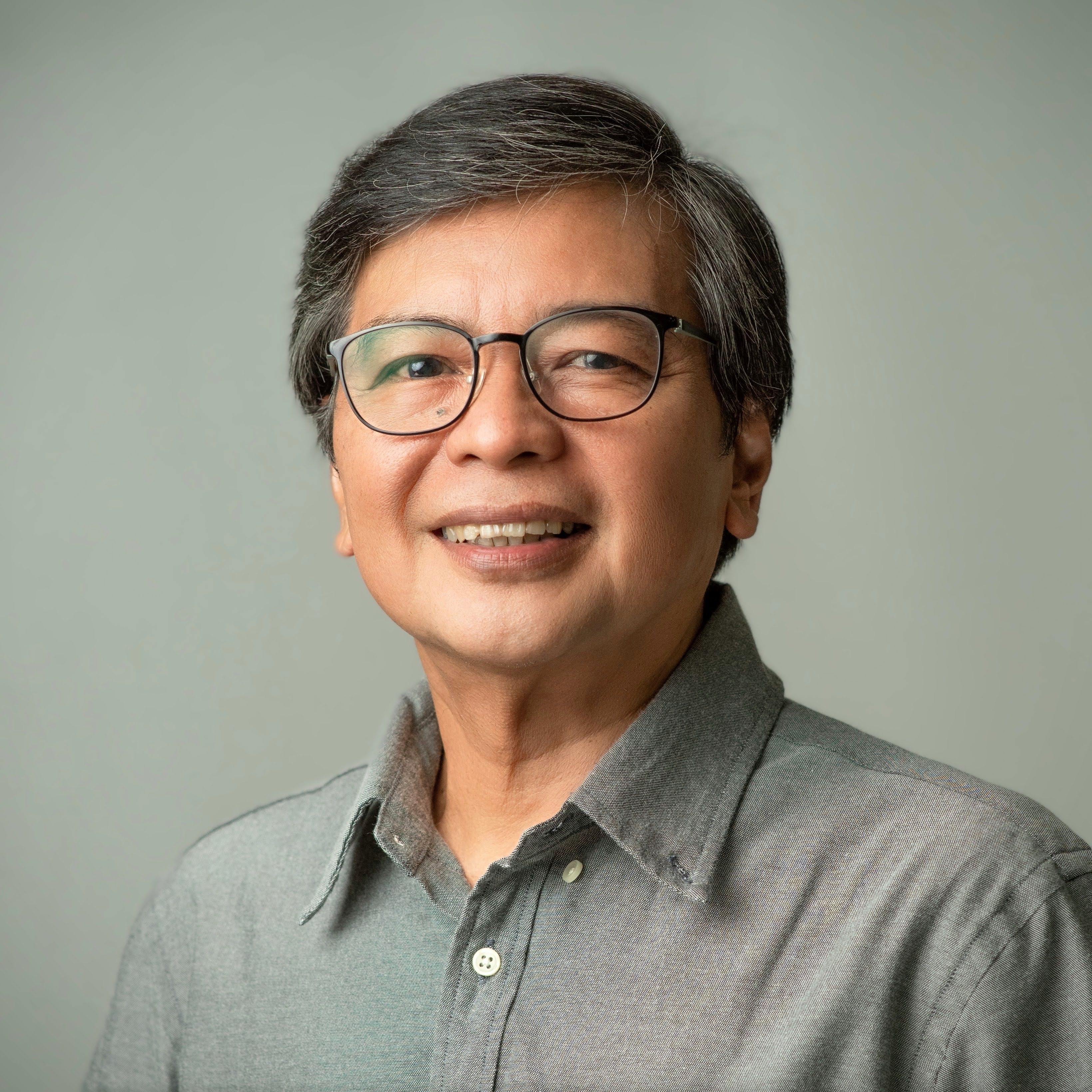
JOSE MARIA P. BALMACEDA (1960–2026)
The UP Diliman Institute of Mathematics mourns the passing of Professor Emeritus Jose Maria P. Balmaceda, fondly known to generations of students and colleagues as Joey.
Professor Balmaceda joined the UP Department of Mathematics as an Instructor in 1981, immediately after graduating magna cum laude and as valedictorian of the BS Mathematics program. He obtained his MS Mathematics degree from the University of the Philippines in 1983 before pursuing doctoral studies at the University of Illinois at Urbana-Champaign, where he earned his PhD in Mathematics in 1991. Upon his return to the country, he continued his service to the University, rising through the academic ranks to become Professor 12. Over more than four decades, he devoted his career to advancing mathematics through teaching, research, academic leadership, and public service.
Few people knew the Institute of Mathematics and the University as intimately as Professor Balmaceda. Having been both a student and later a colleague of
many of the Institute’s pioneering faculty members, and subsequently a mentor and teacher to succeeding generations of mathematicians, he served as a bridge across generations. He participated actively in every aspect of the Institute’s life, from teaching and curriculum development to research, extension, and academic administration. His breadth of experience, sound judgment, and profound knowledge of the University made him an invaluable source of counsel for colleagues and academic leaders alike.
As a key figure in the Institute’s history, Professor Balmaceda helped transform the former Department of Mathematics into the Institute of Mathematics and contributed to every major revision of its undergraduate and graduate curricula over the past three decades. His vision, thoughtful leadership, and unwavering commitment to academic excellence helped build the Institute into the nationally and internationally recognized center for mathematical research and education that it is today.
A distinguished scholar in group theory, representation theory, and algebraic combinatorics, Professor Balmaceda introduced new research areas and advanced courses that broadened the Institute’s research and graduate programs. He mentored generations of undergraduate and graduate students, many of whom have gone on to become leaders in mathematics education and research in the Philippines and abroad. He also helped shape the University’s mathematics curriculum, including the development of the General Education course Mathematics, Culture and Society, through which he inspired thousands of students to appreciate the beauty, power, and relevance of mathematics.
Beyond the University, Professor Balmaceda provided distinguished leadership to the mathematical community at both the national and international levels. He served as President of the Mathematical Society of the Philippines and the Southeast Asian Mathematical Society, chaired the CHED Technical Committee for Mathematics and the Mathematical Sciences Division of the National Research Council of the Philippines, and represented Asia on the Commission for Developing Countries of the International Mathematical Union. In recognition of his outstanding contributions to mathematics, he was elected an Academician of the National Academy of Science and Technology in 2008 and received numerous awards for excellence in teaching, research, and public service.
In many ways, Professor Balmaceda embodied the culture that the Institute has always sought to nurture: excellence in teaching, scholarship, and service, coupled with a deep sense of responsibility to his students, colleagues, and the University. He possessed the uncommon ability to see the bigger picture: the place of mathematics within the sciences, the role of the Institute within the University, and the responsibility of the University to society. That perspective informed everything he did as a teacher and mentor, researcher and administrator, and helped shape the character of the Institute itself. His influence can be found not only in his publications, his students, and the
institutions he helped build, but also in the values he exemplified and passed on to all who had the privilege of working with him.
Joey will be deeply missed. His scholarship, generosity as a mentor, devotion to teaching, and enduring dedication to the advancement of mathematics have left an indelible mark on the Institute, the University, and the mathematical community. His legacy will continue to inspire generations of mathematicians, educators, and students.
The Institute of Mathematics extends its deepest condolences to his wife, Marlu, his son, Benjamin, and all his family, friends, former students, and colleagues.