Closing Message for Congruence and Convergence
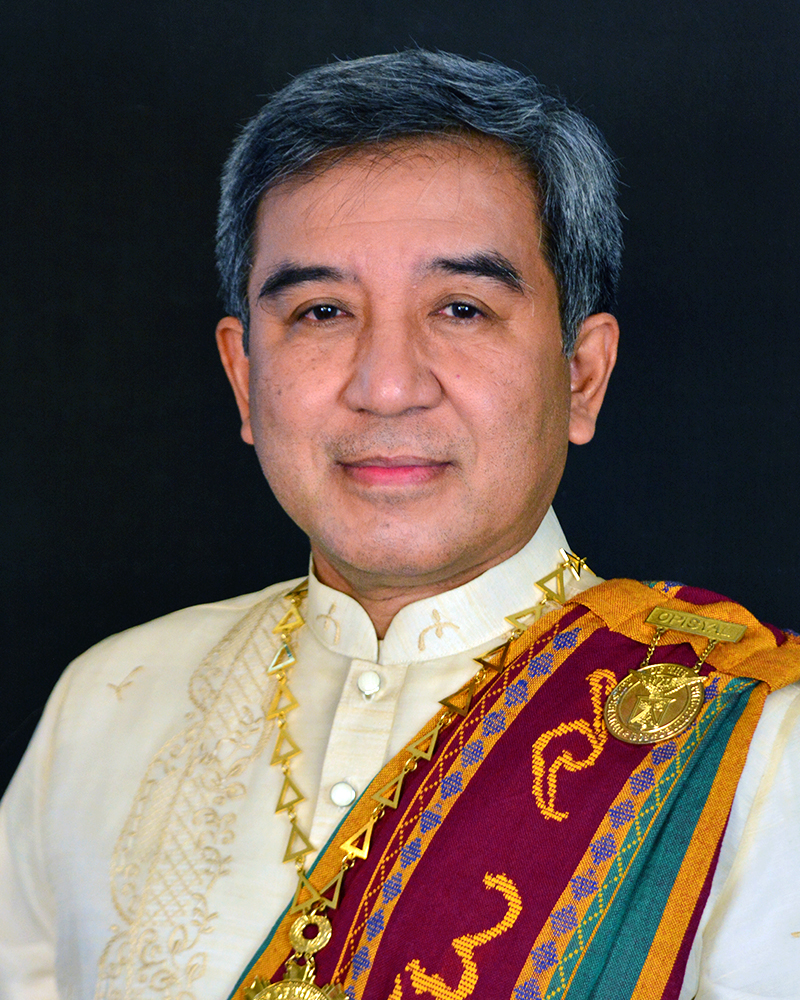
Fidel Nemenzo
23 Feb 2025, UP Learning Commons
When my mentor Professor Wada retired in 2005, it was a strange moment for mathematics, at least in Japan. Departments of mathematics were being absorbed into IT departments. Everything was being reorganized, rebranded, justified in the language of the market, efficiency, and usefulness. I remember him saying, half-joking, half-sadly, “It’s a good time to retire; our math department is disappearing anyway.”
It really was a time of great change. And I remember thinking then: maybe this is what retirement feels like. Not just leaving an institution, but leaving one version of the world.
I have to admit I feel something similar. Since returning to the classroom after many years of university administration, I sometimes feel that I no longer quite know how to teach. Students today engage with knowledge differently. Many don’t take notes in class, they take photos. They navigate information by googling rather than reading. When they encounter a difficulty, they reach outward- to networks, apps and tools, communities, rather than sitting alone with a problem. They have the internet, powerful software, and more computing power in their pockets than we had in our entire department when I was a student.
And now we speak the language of OBE or Outcome-Based Education, and look at outcomes, measurable competencies, performance indicators. There is clarity in that, and perhaps accountability. But there is also a subtle shift. Sometimes education begins to sound like a product to be delivered rather than a process to be lived.
In the classroom, I have always been more interested in the process—the exploration, the false starts, the groping in the dark, the long silences, the moment when a student says, “Aha, I think I get it.” Mathematics, at least as I have loved it, is not just about arriving at the correct answer. It is about learning how to think, how to question, how to wander intelligently through confusion. Those things are harder to measure, but they are habits of the mind that endure.
I suspect this is also why I struggle with online teaching. I have always preferred the blackboard and the dusty chalk work. A mathematical proof written slowly, line by line, mirrors the way thinking actually happens. The earlier steps remain on the board, so we can return to them, question them, build on them. We can point back and say “This is where we used that assumption,” or “this is the step we must now show.” Slides are efficient, but they are too complete, too quick. But mathematics, at least as I have learned it and tried to teach it, is not always a finished product. It is something that unfolds and is constructed in front of you, occasionally messy and oftentimes beautifully, from one idea to the next. Many of you know this.
But the changes go deeper than pedagogy. Mathematics itself is changing. Computers are no longer just tools. They’re collaborators, sometimes even competitors. AI is now solving problems we used to think were uniquely human. This morning Raul Fabella lamented that human thinking has led to a lot of mess, and proposed that we work with AGIs, or mechanical Dr Spocks to run our institutions and economy. Vicman Aricheta and I had a short conversation about AI not long ago. An existential conversation. What does it mean to be a mathematician when machines can now do mathematics?
But then I remind myself of something I learned long before Google, long before AI. Even then, the information was already there—in books, in journals, in libraries. Teaching mathematics was never really about transferring information. What we were really trying to teach was how to think: how to sit with confusion, how to be precise without becoming rigid, how to recognize beauty in structure, and how to accept that sometimes you work on a problem for weeks and the only thing you gain is another, perhaps, better question.
Prof Wada understood this deeply. He once told me he would be doing mathematics until the end, unlike the number theorist GH Hardy, who famously lamented that mathematics is for the young, and whose book A Mathematician’s Apology reads more like the memoir of a lapsed mathematician. For Wada, mathematics was not performance tied to age. It was a way of being in the world.
I’ve always been drawn to very basic questions. What is mathematics, really? What is a number? These are questions I genuinely love. Bertrand Russell once said that mathematics is the subject in which we never know what we are talking about, nor whether what we are saying is true. I’ve spent a lifetime in a discipline that is perfectly comfortable with that level of uncertainty. And maybe that’s why this current moment shouldn’t frighten me as much as it might.
One thing we’ve all learned is that mathematics is not really about numbers. It’s about patterns. Sudoku, for example, isn’t really about numbers at all—you can replace these with letters or symbols and the game remains the same. What matters are relationships, constraints, structure. Mathematics is ideas, and also language: a disciplined language that allows us to communicate those ideas to each other with precision.
Allow me to respond to the question raised by Carmen Amarra earlier, after Willy Alangui’s talk on ethnomathematics, which might have seemed to be unfairly critical of Western mathematics.
Mathematics is created by humans. As human activity, it is culturally embedded. Our ways of doing, living and understanding have context- historical, social, cultural, and political. By looking at context, we challenge the view that mathematics is purely neutral, universal or culture-free.
True, 163 is a prime number, 7+11 = 18 regardless of time, place, or culture. Wherever, whenever, the principle is the same. But the ways we discover, express, teach, and use this truth are cultural. They are shaped by language, tools, needs, and values. Symbols may differ, number words differ, algorithms differ, motivations and applications differ.
When we say that “mathematics is universal” yet ignore context, we dehumanize it. we erase local mathematical traditions and privilege dominant narratives, mostly defined by the West, by colonial powers. We also end up teaching mathematics to many students as a subject that feels alien to their lives.
What Willy asserted was that when we challenge the dominant narrative, we “decolonize” mathematics; we release it from colonial assumptions. Decolonizing math does not mean rejecting mathematical rigor or the mathematics of the West. It means broadening the story of mathematics and how we teach it, so that rigor is informed by more sources, more questions, more voices.
I admit I didn’t actually enjoy math classes very much as a child. Classroom math was joyless; an endless routine of drills and exams. But what I enjoyed was playing with wooden blocks—building things, arranging them, discovering patterns. Only later did I realize I was already thinking mathematically.
And there was a moment during my early school days I still remember very clearly. I once asked my mother: if I dipped a ball in ink and placed it on the floor, what mark would it leave? She said, of course, a round black blob. I said —if it were a perfectly round ball, it should leave just a tiny dot, or maybe no dot at all. Of course, she was right, but so was I. What I loved was the argument itself, because for the first time I experienced absolute clarity of thought. Years later, I learned that what I was thinking about was a circle tangent to a plane— they meet at a single point. That feeling of clarity was intoxicating. I think I’ve been chasing it ever since.
I saw that same joy in my mentor Prof Wada. Once I asked whether a pattern I had noticed was a coincidence. Instead of answering, he began pacing excitedly around his office, eyes on the floor, smiling broadly. At that moment I thought: this is what mathematics should be—playful, alive, joyful. After a few moments he explained why it was not a coincidence at all, and pointed me toward cyclotomic fields. And for the next year, I studied just that. That kind of joy his greatest gift to his students.
I come from one of the purest branches of mathematics—number theory— which, before the world wars, was a refuge for mathematicians who wanted to remain unsullied by real-world applications. Although long considered abstract and useless, number theory is now indispensable for the cryptographic systems that keep our computers and internet secure. The distinction between the pure and applied turns out to be less rigid that we once imagined.
As Clem Camposano and Cynthia Bautista had argued, what we call basic research and applied research should not be seen as opposing categories, Often they are only different moments in the life cycle of an idea. An idea pursued for its own beauty may later turn out to be indispensable. Utility is sometime delayed, sometimes unexpected.
This is why I want to make a plea— for support for the basic sciences, for the humanities, and yes for fields like number theory and coding theory. Amid market pressures the instinct is to prioritize what appears to be immediately practical. But a university must defend and nurture spaces where ideas are allowed to flourish without immediate returns. If we fund only what promises short term return of investments, we diminish the future.
We need to dispel the myth that science and technology are neutral. Mathematics and science are adventures of the mind with real consequences. Technology shapes society—our culture, our values, our institutions—and society, in turn, shapes the development of science. Science has context and is shaped by it: historical, cultural, social, ethical. AI, machine learning and other new disruptive technologies will profoundly impact on how we live, how we work, who gets opportunities, and who doesn’t. Our students need to understand not just how these systems work, but what they mean, what they assume, what they value, and what they exclude.
This is why the liberal arts, as embodied in our General Education program- matter. They teach us how to learn, how to unlearn and relearn, how to adapt. They teach us to question assumptions, to see connections, to understand context, to consider consequences. In a fast changing world where technical skills quickly become obsolete, it is the capacity to think- critically, ethically, historically- that endures. Universities need to nurture this kind of education, now more than ever.
Alongside this shift, we have also become increasingly governed by metrics: publication counts, h-indices, impact factors, global university rankings. Metrics can be useful. As a mathematician, I am not opposed to numbers. But I worry when our worth, as institutions of learning and public service, is reduced to numbers.
Excellence has been equated with competition- visibility, citation counts, our place in rankings. This narrows inquiry, discourages intellectual risk. It favors institutions that are already wealthy and well-resourced, encouraging alignment with a particular global model of the university that is largely shaped in the North.
What metrics cannot capture is often what matters most: the slow development of an idea, the mentoring of a struggling student, the courage to pursue an unfashionable problem, the building of programs that serve the nation rather than the rankings table. Rankings do not measure educational depth, quality of teaching, institutional character, and social responsibility.
We should look beyond outputs alone and attend to the conditions under which knowledge is created: university governance, the culture of a department, the integrity of its scholarship, the generosity of its mentoring, the academic freedom to pursue unfashionable and uncomfortable questions. The freedom to critique prevailing models and power structures. Real quality lies not only in what we publish, but in whether we encourage and nurture collaboration, equity, curiosity, and intellectual courage.
If we allow rankings and market pressures alone to dictate our priorities, we risk becoming efficient but diminished. Excellent by external metrics, yet uncertain of our own intellectual soul. A university must decide what it stands for before it decides how it will be measured.
I’ve spent more than three decades in this Institute, and more than half a century in this university. I’ve watched generations of students come and go— some brilliant, some struggling, many surprising us in ways grades never predicted. One of the real joys of teaching is seeing students find their own paths, often in directions you never imagined. I’ve taught students who later became colleagues, and colleagues who became friends.
Some of these former students are now among the speakers and organizers of this conference, doing excellent research in number theory, coding theory, and algebraic combinatorics, and mentoring the next generation of mathematicians. That brings me a special kind of joy.
And thank you for this most special gift—an academic conference held over a quiet weekend on campus, when life in UP moves at a gentler pace. That you would choose to spend these days thinking, conversing, and building community together is something I will truly cherish.
I’m deeply grateful to my colleagues here for the meetings, arguments, discussions, the fun conference adventures, and for the shared belief— sometimes loudly proclaimed, sometimes quietly assumed—that mathematics
matters even when no one is watching. You made this a place where it was possible to grow, to disagree, to fail, and still belong.
Thank you to speakers in this conference, for sharing your mathematics, stories and perspectives. Special thanks to my mathematics colleagues from overseas- Kiyoshi Nagata, Koichiro Akiyama, Michel Waldschmidt, Francesco Pappalardi, and Valerio Talamanca, for traveling to the Philippines to join this conference, and for your continued support to Philippine mathematics.
To the younger faculty and students: yes, mathematics is changing. Universities are changing. The rules are shifting under your feet. But that has always been true. Every generation thinks it is living through the end of something—and maybe it is—but it is also always living through a beginning.
As for me, I don’t feel that I’m leaving mathematics. I’m just stepping aside, trusting that it will continue—here, in this Institute, in forms I may not fully understand anymore. And that’s fine. Not understanding everything is not a failure. It’s an invitation to remain curious.
So today, I just want to say thank you—daghang salamat kaninyong lahat- for the years, for the friendships, for the shared life of the mind. It has been a deep honor to belong to the Institute of Mathematics and this university.